Monday, March 24, 2014

Introductions
As a seventh grade ELA teacher,  I have come to recognize that many students struggle with how to start a composition.  Although there are several ways to start an introduction, I have chosen five strategies for students to use to begin their introduction.  These strategies have been especially helpful as we prepare for the MCAS long composition. With the use of WBT gestures, students finally feel comfortable starting a composition on their own. We also used these strategies in our Writer’s Workshop narrative unit. The five strategies that we focus on are sound, dialogue, story, thought and question.  Dialogue and question are the most commonly used among students. 
Check out the video below to see the students in action practicing their gestures.


Check out our teachers pay teachers account for WBT powerpix and a student handout. http://www.teacherspayteachers.com/Store/Becky-And-Kellie

Thursday, March 6, 2014

Einstein Triangle: Compare, Contrast, Connect

Today, we used Einstein Triangles to develop a piece of writing that compared, contrasted and connected photosynthesis and cellular respiration.  Again, the students first used a graphic organizer to organize and generate their ideas.  We used the same type of frame as last week but added for example.  Instead of working with me, the students worked with a partner to generate their essay.  Even though I gave the students the frame for writing, they used their own work to organize their ideas.  I'm pleased with the products because they are a result of student ideas, and I'm looking forward to reading them because they are all different.  Their work is a result of serious consideration about which ideas they were comfortable communicating not ones I suggested they write.  Some students did need assistance with word choice but not ideas.  They were  proud of how "smart" their explanations sounded.  They completed the assignment in one day, and we will share a couple with the whole class tomorrow using mirror.  Next time, after the whole class discussion, students will complete the writing on their own.  They did a great job!

Monday, March 3, 2014

Einstein Triangles

Last week,  we used Einstein Triangles to practice critical thinking skills and provide a means for students to use Mirror and Teach-ok with ideas generated by themselves and their peers.  We incorporated the Common Core Reading Strategy for Science 6-8.9, and I provided the student's with a paragraph frame to organize their ideas into a written piece.
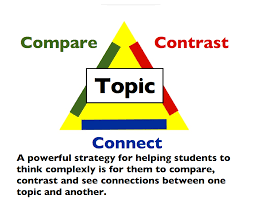


Our topic was photosynthesis and we used Einstein Triangles to compare, contrast and connect three articles about 1 topic.  First, using a graphic organizer for RST 6-8.9, the students generated a list of similarities and differences among the three sources we used to collect information about photosynthesis.  They used these ideas to help them compare, contrast and connect.    We went through each step together looking first for  the ideas that  were similar in each source.  We then identified differences in the sources and ended with connections.  The students used gestures for similar, different, connect, also, but, in conclusion and we used the because clapper.  The next time, when we compare, contrast, connect photosynthesis and respiration we will add for example.  Below is student sample paragraph created using a provided frame.  The parts of the frame are in bold.


These three sources are similar because all three discuss photosynthesis, raw materials and glucose.  Also, all three include ideas about where certain materials enter, but they don't all use the term "inputs".  These three sources are different because not all them include chlorophyll, the history of photosynthesis or the literal meaning of the word.  Also, the video included reasons why the leaves change color but doesn't discuss pigments like the worksheet.  These three sources are connected because they remind me that every living thing is organized.  In conclusion, all three of these sources are organized differently but focus on the same topic of photosynthesis.


The whole lesson took two days. We used about 20 minutes to introduce and review the proper gestures.  Next time, we won't have to do this. In my opinion, it was well worth the time.  The conversations the kids were having were focused and meaningful.  Watching them help each other decide on similarities and differences was very authentic and forced them to spend time with their resources looking for evidence.  Even though I gave them the paragraph frame, they still needed to consider their word choice and be sure it read fluently.  When we did Mirror and Teach-ok, the focus changed from always watching me for ideas but to being about using their own ideas. All I had to do this time was model how the Mirror would look using Einstein Triangles gestures.  It was very student centered.  Their ideas were relevant and thoughtful.  Today, Monday, they showed they had much control over the topic as we worked to explain the chemical formula.  In the end, we addressed important science and common core standards, and, with the help of our gestures,  had a good time doing it!  Success.

If you haven't checked Einstein Triangles, you can see more about them at WBT website.  If you search for them in the forum, there is a free download to help you get started.  For my 7th graders at this point in the year,  I felt like I needed to make some modifications to the pacing.  Regardless, the approach provides a great structure for supporting critical thinking among all students.  Not only do they help to keep everyone involved but the structure keeps each learner challenged as well.  This was evident in their writing.  This student evidence provided me a means of offering feedback and support as we moved forward.


Friday, February 7, 2014

Amping Things Up!!!


Rolling ten finger woo for all of us!! We have hit the halfway mark.  Thus far, this has been one of the most successful school years.  Post test scores and productivity are up.  However, by the looks of my score board , it is apparent that the students are ready for new challenges.  For WB certification, it is required you submit a sample video  using WB strategies in the classroom.  I sent mine in and got some valuable feedback in, what feels like, just the nick of time. 


Moving forward, my challenge is to include more critical thinking activities within our whole brain instruction.  Critical thinking is the third step in WB five step lesson plan.  The sample video below highlights students using critical thinking skills to develop a response using ideas related to diffusion.  Generally, the kids do this kind of thinking in smaller groups.  The WB lesson plan encourages this type of thinking within the whole group using teach-ok and switch.  By embedding the critical thinking component and switch more often within the whole group I can move around the room and monitor more students.  It also ensures that I keep an eye on engagement and be sure we have 100% participation.  Another strategy I will begin to include is Einstein’s Triangle.  I still need to spend some more time with the format, but Einstein’s Triangle supports the kids thinking by having them look for ways the two concepts are alike and different.  The triangle also requires the kids to make connections with previously learned ideas.  More importantly, the students will speak answers in paragraphs! 


The video shows the kids using gestures to prepare to Mirror an explanation about cellular behavior in osmotic solutions.   There are six groups, and I will use their Mirrors to help us to begin to do this kind of critical thinking together using teach-ok, switch and Einstein’s Triangle.  I'll let you know!!

Saturday, February 1, 2014

Establishing Goals


           I had my students create goals for the New Year.  I generally have students reflect on how far they have come since September and then establish goals for the remainder of the year. This year the goals are much more meaningful because they truly know and BELIEVE in the classroom expectations. I really feel confident with goal setting now because students are well aware of what they need to work on because I have already provided the feedback on how often they follow the classroom rules. The Super Improver Wall is also an added bonus to motivate students to achieve their goals.

             After students have reflected on their growth and what they need to work on I had them record their goals on a goal card that they need to keep on their desk to remind them of what their focus is.  I also did this at the beginning of the year and it worked well. I am hoping the second time around it will work even better.


Check out  http://www.teacherspayteachers.com/Store/Becky-And-Kellie to download a free copy of the goal cards!

Saturday, January 25, 2014

Teachers Pay Teachers

You can find  FREE Whole Brain Teaching resources at Teachers Pay Teachers by searching for Becky and Kellie or using http://www.teacherspayteachers.com/Store/Becky-And-Kellie. Soon you'll  see other free materials created for our classrooms.
Enjoy

Sunday, December 29, 2013

Feedback


        Providing students with feedback regarding their classroom behavior has been such a rewarding experience. I decided to collect data on four different criteria and observe students biweekly.  To collect this data can be a bit time consuming especially when you are also focusing on teaching and utilizing WBT strategies, but then again, as B said in her previous post about feedback,  "there are not shortcuts to being an excellent teacher!"(Thanks Coach Biffle) B and I both provide students with feedback and in collaborating with B and sharing our data we realized that just a few students were “not making smart choice.”   We meet with these students and talk about what this looks like. The Guff counter has been a great way to keep students on track as well!

In the middle of December I provided students with a feedback form that I stapled to a progress report. Students often focus on their assessment scores and final grades that they see on progress reports and report cards, so when they received a progress report with a stapled copy of the percentage of times they raised their hand for permission to speak, followed directions, stayed on task and completed assignments they were surprised and grateful.  I could see the switch go off for many of my students that their grades are not just a number on a quiz but are a reflection of their classroom engagement, participation and behavior.  Below is a copy of the feedback form attached to a progress report. 

K